Cathedral of the Annunciation of the Blessed Virgin Mary and Saint Nathy, Ballaghaderreen
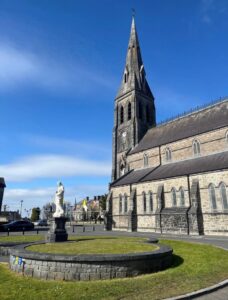 The Cathedral of the Annunciation of the Blessed Virgin Mary and St. Nathy is the Cathedral Church of the Diocese of Achonry. Located in Ballaghaderreen, County Roscommon, the Cathedral was commissioned in 1855.
The Cathedral, commissioned to be built by Bishop Patrick Durcan in the Gothic style, was begun in 1855 and completed in 1860. Durcan had come to the diocese several years earlier and wanted a new Cathedral to meet the needs of the people of Ballaghaderreen.
This initial part of the Cathedral consisted of an “eight-bay nave with clerestory and lean-to side aisles, a four-stage tower with spire to west, square-ended chancel to east with sacristy and mortuary chapel to north and south.”
The new Cathedral was consecrated and opened in November 1860.The bell tower of 59.6 meters with a needle and a carillon of bells and a new sacristy were all added in 1912 by the project architect, William H. Byrne Irish. Because of its height, the body of the church in grey limestone seems small but is 45.72 metres (150 feet) long, 17.9 metres (59 feet) wide and 20.4 metres (67 feet) high.The interior has a single nave. South of the west door is the baptismal font dating from around 1870.
Cathedral of the Immaculate Conception, Sligo
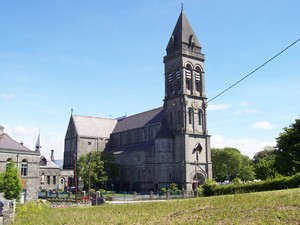 The Cathedral of the Immaculate Conception was solemnly opened on the 26th July, 1874 by Cardinal Paul Cullen of Dublin. The Cathedral was consecrated until on the 1st July, 1897 and dedicated in honour of the Immaculate Conception of the Blessed Virgin Mary. The Diocese of Elphin again had a Cathedral after a three hundred-year lapse in the wake of the Elizabethan Reformation.
The man responsible for the building of the Cathedral was Bishop Laurence Gillooly. Appointed Bishop of Elphin in 1858, Bishop Gillooly decided that it was time the Diocese again had a Cathedral. Since 1827 St. John’s Parish Chapel, which stood near where the Avalon Centre, Sligo is today, was recognised as the Pro Cathedral of the Diocese while Bishops had, for the period since the expulsion from Elphin itself, moved from place to place.
In 1859 Bishop Gillooly secured a renewable lease from Sir Gilbert King of two adjacent properties close to the Lungy one of which was known as the “Bowling Green”. This was to be the site for the new Cathedral. The architet was George Goldie of London while the main contractor was Joseph Clarence of Ballisodare.
Work commenced on the Cathedral in 1869. The exterior of which is built in cut limestone. Modelled on a Normano–Romano–Byzantine style it is the only example of a Romanesque style Cathedral built during the 19th century. Designed in the shape of a basilica, the church has a square, pyramid-capped tower, which reaches a height of 70 metres, and supporting turrets at the west end. The tower incorporates the main entrance to the building. The cruciform Cathedral is sixty-nine metres wide at the nave and aisles, and nineteen metres in height to the apex of the nave roof. It is a very spacious building with side galleries and choir loft. Arches, supported by eighteen massive stone pillars of finely chiselled limestone, connect the nave and aisles.
The arch over the main entrance has a series of scriptural figures sculpted in ‘alto rellevo’. The three-faced clock tower, designed by Gillet & Bland of London in 1877, is one of the finest examples of a nineteenth-century turret clock, and the carillon, comprising nine bells, has few comparable to it in Ireland. The largest weighs 1,456 kg, and is dedicated to Our Lady. All the bells are beautifully decorated with the harp and shamrock and the chimes are a familiar sound to all Sligonians.
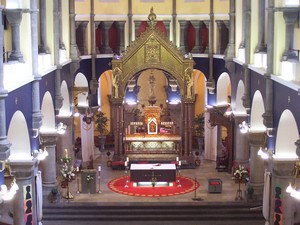 The original high altar was considered one of the finest in the country, surmounted by a brass baldachino and reached by six marble steps. The tabernacle was flanked by two carved panels depicting the sacrifices of Abraham and Melchisidech. The baldachino and high altar recall, in beaten brass, the artisanship of Asicus, the first Abbot – Bishop of Elphin and Patron of the Diocese, whose wood-carved statue is enshrined in the Cathedral. There are two side altars in the transepts, one dedicated to the Sacred Heart the other to Saint Joseph.
The circular baptistry,incorporated in the aps with its five lancet windows behind the highaltar,was originallydesigned as a mortuary chapel.
The Cathedral crypt lies immediately beneath the baptistry, where the remains of Bishops Gillooly, Clancy and Coyne were laid to rest and now await the Resurrection. One of the chief attractions to the building is its stained-glass windows supplied by Loblin of Tours in France.
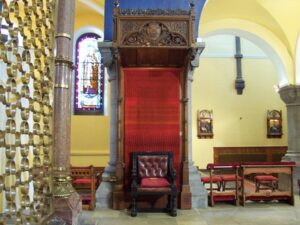 The Bishop’s Chair occupies a prominent place in the sanctuary set against the double pilaster with the corresponding pilaster on the other side of the sanctuary displaying the Elphin Diocesan coat of arms executed in marble.
The Cathedral has undergone extensive renovations on two occasions since it was erected. The most recent remodelling of the sanctuary in 1974 – 75, to comply with the revised liturgical norms, was expertly carried out ensuring a very sensitive blend between old and new.
The sanctuary was extended at the level of the high altar. A new altar, which occupies a central position on a raised dais, is of cut limestone and complimented by a matching ambo and presiders chair. The original high altar has been beautifully preserved, along with the brass baldachino.
This much admired Cathedral, with its picturesque Ben Bulben backdrop, stands as a memorial to the faith of generations of Catholics in the Diocese of Elphin. This edifice, with its old world of architecture, provides a reflective and prayerful environment for Christian people in every age, and an oasis of hope for those who strive to love and serve God.